


Winter work outfits have to suit more than the office. There is the walk to the station, a crowded train, a chilly meeting room and, sometimes, heating that turns the afternoon into a completely different season.
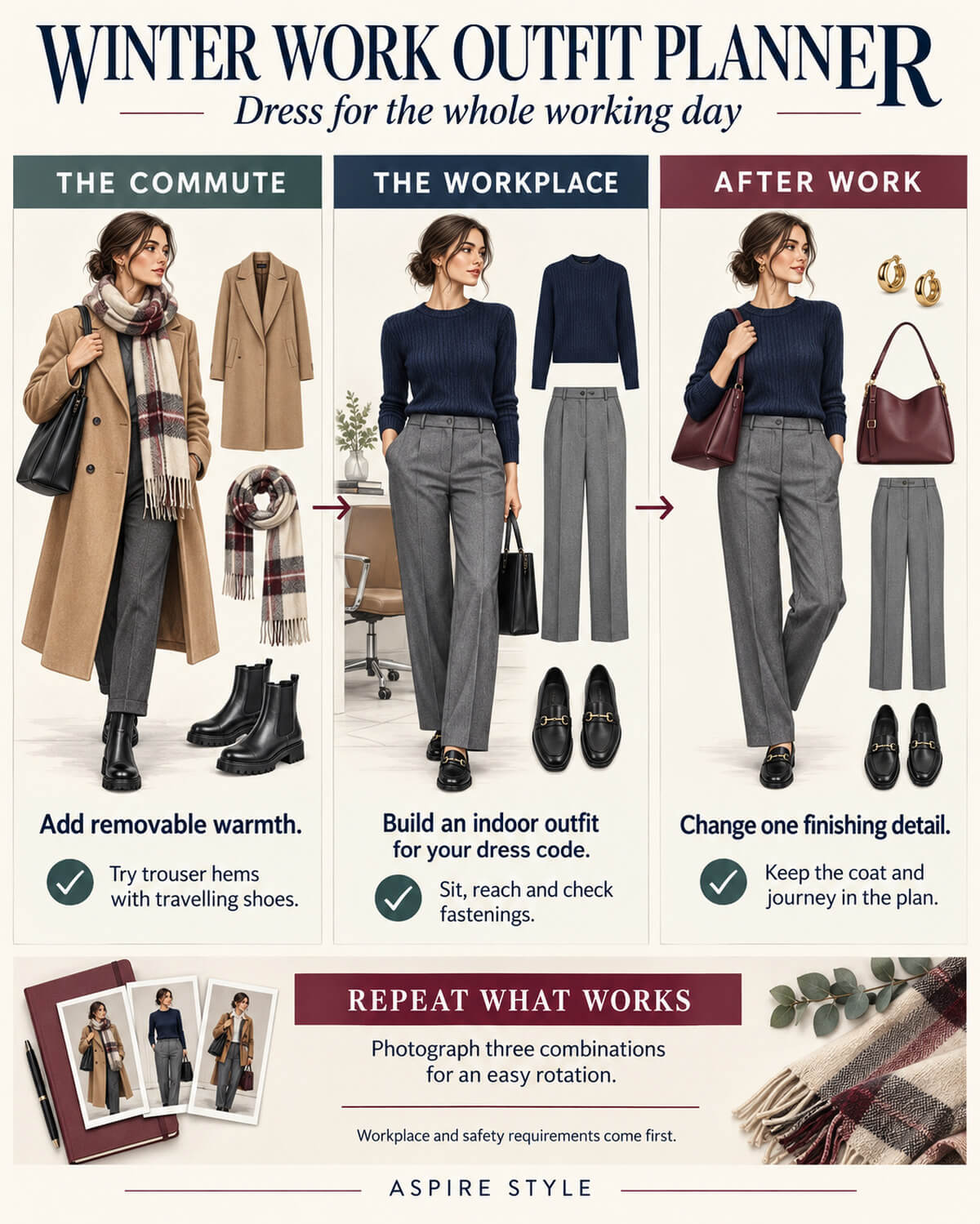
A useful starting point is an indoor outfit that meets your dress code, with removable warmth for the journey. Think fine knitwear, trousers or a skirt you can sit in comfortably, and shoes chosen for the route. Add the coat last, once you know it fits over everything underneath.
These seven outfit ideas cover different working days, from formal meetings to a casual Friday. Adapt them to your workplace: uniforms, safety requirements and an employer’s dress code take priority over styling suggestions.
Plan for your coldest and warmest moments
Consider where you will actually spend the day. If you walk for half an hour but sit in a warm office, removable outer layers may be more useful than a very thick jumper. If your workplace stays cool, a cardigan or knitted vest you can keep on indoors may be the better starting point.
Keep a spare pair of shoes at work if that is practical for you. This lets you choose footwear for a wet journey without expecting a delicate office shoe to do every job. Try trousers with both pairs: a hem that suits a heeled boot might drag when you change into flats.
For help getting the layers to fit under your coat, start with our guide to layering clothes for winter without feeling bulky.
1. Fine roll neck, tailored trousers and a long coat
This is an easy starting point for an office that expects smart separates. Try a charcoal roll neck, navy straight-leg trousers and a camel or dark coat. Add polished ankle boots or closed shoes that work with the trouser length.
A fine knit usually sits more comfortably under a tailored coat than a very chunky one. Check the neckline for comfort before committing to a roll neck for a full day; a crew-neck jumper or fine cardigan can fill the same role if you dislike fabric around your neck.
Keep a belt optional. The trouser waistband should fit comfortably on its own, with enough room for the way you plan to tuck the knit.
2. Shirt, knitted vest and wide-leg trousers
A knitted vest adds another layer through the body without putting extra jumper sleeves beneath a blazer or coat. Choose a shirt that allows you to reach forwards at your desk, then add wide-leg trousers and closed shoes.
Try a pale blue shirt with a navy vest and grey trousers. Let the collar show, or leave the shirt’s top button open if your dress code allows. Smooth the shirt down before adding the vest so the fabric does not gather awkwardly at the waist.
Check the trousers on stairs and outside. For a wet commute, a hem that clears the ground is more useful than one chosen only for how it looks while standing still.

3. A midi dress with tights and knee-high boots
A long-sleeved midi dress reduces the number of separates you need to coordinate. Choose one with comfortable sleeves and enough ease to sit, then add tights and boots. A woven dress can work as well as a knit; the cut and your office’s expectations matter more than the label.
Test the dress over the boots while walking. The skirt should move freely rather than catch on the shafts. Sit in the outfit too, checking the hem, any buttons and the waistband.
For a colder room, add a cardigan you can keep at your desk. If the cardigan makes the coat sleeves crowded, carry it in your bag and put it on when you arrive.
4. Matching tailoring with a fine knit
For a presentation or more formal meeting, a trouser suit with a fine knit underneath can be a comfortable winter option where the dress code permits. A shirt or blouse may be more appropriate in a stricter workplace.
Try navy tailoring with a cream crew neck, or charcoal with a burgundy knit. Put the blazer on under your coat before the morning you need it. If the shoulders feel tight, change the outer layer rather than spending the commute with the blazer compressed underneath.
A simple necklace or pair of earrings can finish the outfit, but there is no need to add jewellery to every look. Keep anything that catches on knitwear or gets in the way at your desk for another occasion.
5. A cardigan worn as a top with a midi skirt
A buttoned cardigan and midi skirt make a softer alternative to tailoring. Try a navy cardigan with a grey A-line skirt, tights and ankle boots. Wear a light top beneath if you want the option to open or remove the cardigan.
Check the buttons while sitting and reaching. If the front gaps, change the fit or wear the cardigan open over a separate top. A shorter cardigan can sit near the skirt waistband without needing a thick tuck.
Choose a skirt with a lining or enough room to move over your tights. Test it by walking across the room, rather than assuming it will hang the same way all day.
6. Dark jeans, a knit and a blazer for a relaxed office
If denim is welcome at work, dark straight-leg jeans with a fine jumper and a blazer provide a useful casual option. Finish with ankle boots or another closed shoe suited to the day.
The distinction comes from the details: jeans that sit comfortably at the waist, knitwear without loose threads, and a blazer whose sleeves do not bunch under your coat. Use a coloured jumper if a dark outfit feels too plain.
A puffer can be a practical outer layer for this combination. Our puffer jacket outfit guide includes ways to pair padded outerwear with tailored trousers and other everyday pieces.
7. Textured trousers and a simple top for desk-to-dinner plans
When you have plans after work, begin with trousers that already fit your workplace: perhaps a fine cord, a subtle check or a plain tailored pair. Add a simple top and removable cardigan or blazer.
Pack one small change for the evening, such as earrings or a compact bag. You do not need a full second outfit. A fine black knit and tailored trousers can look different once the work tote is put away and a more decorative accessory is added.
Keep the coat and suitable travelling shoes in the plan. Evening footwear is only useful if it works for the journey, or if you can comfortably change when you arrive.
Build a rotation you will actually wear
Pick three of these combinations that suit your real week. Lay out the pieces, try them on and photograph the complete outfits. Notice which top works with more than one bottom and which coat can accommodate your most-used layers.
You might repeat the same trousers with a roll neck on Monday and a shirt with a vest on Thursday. That is a useful wardrobe doing its job. Our practical capsule wardrobe guide can help you identify those repeatable combinations before filling any gaps.
Between wears, check cuffs, buttons and hems so small repairs do not become morning surprises. Follow the individual care labels; Woolmark’s care guidance is a useful reference for wool pieces. A reliable winter work wardrobe should be manageable on laundry day as well as a Monday morning.


